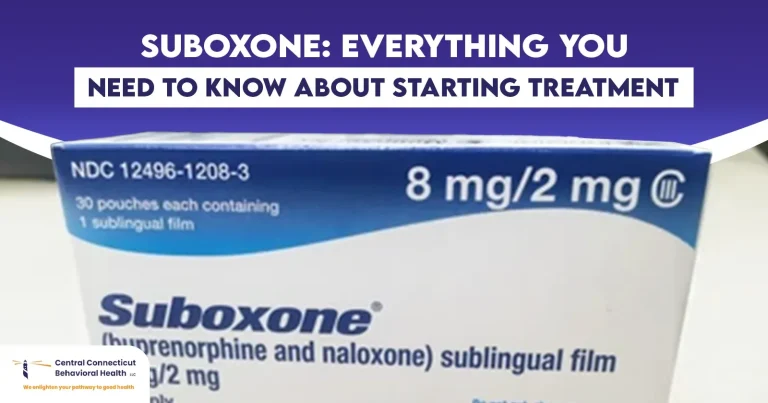


One big question that people have when starting treatment for opioid addiction is, “How long does Suboxone stay in your system?”
This information is vital to recovery, drug screening, and your overall health. Patients also want to understand how long it takes to detect Suboxone, its effects, and how the body metabolizes it.
At Central Connecticut Behavioral Health, we provide personalized care and guidance throughout your journey to recovery.
Our staff works together to educate clients about medications such as Suboxone and develop a safe, effective treatment plan based on evidence.
What Is Suboxone?
Suboxone is prescribed to those recovering from an addiction to opioids.
There are two primary ingredients in Suboxone: buprenorphine, which reduces cravings and withdrawal symptoms, and naloxone, which helps prevent misuse of the medication.
Suboxone is commonly used in Medication-Assisted Treatment (MAT) due to its unique formulation.
Suboxone Half-Life Explained
A Suboxone half-life refers to how long a drug remains in your body until half is out. The Suboxone half-life for buprenorphine (the active ingredient in Suboxone) is long—from 24 to 42 hours on average.
The long half-life allows for a longer time span in your body than most medications. This makes suboxone effective at providing stable relief from withdrawal symptoms and means less frequent dosing is needed.
Due to its long half-life, buprenorphine can remain in your body after you stop using it, which can result in a positive drug test if your urine or blood is still being tested.
How Long Does Suboxone Stay in Your Body Exactly
When it comes to how long Suboxone lasts, there are many different factors; however, in general:
- Suboxone typically stays in the body for about 7-10 days.
- In some cases, buprenorphine half-life can be detected in the body for even longer periods of time.
- The effects of Suboxone can last anywhere from 24 to 72 hours.
Since Suboxone has a very long half-life, when used repeatedly, it’s likely that the medication will build up in the body over time and thus provide effective treatment but also prolong its detectable presence.
How Long Does Suboxone Stay in Urine?
In most cases:
- Suboxone can be detected in urine for up to 7 days
- In heavy or long-term users, it may last up to 10 days
- Detection depends on metabolism and hydration levels
Urine tests are widely used because they are simple and reliable. If you are undergoing testing, it is important to understand suboxone detection time drug test guidelines.
How Long Does Suboxone Stay in a Blood Test?
Typically:
- Suboxone remains in the blood for about 24 to 48 hours
- Buprenorphine levels decrease slowly over time
- Blood tests are less common but more precise
Blood testing is usually done in clinical or emergency settings. It provides a snapshot of current drug levels rather than long-term detection.
Suboxone Detection Time Drug Test
Understanding suboxone detection time drug test results can help patients feel more prepared. Different tests detect Suboxone for different durations:
- Urine: up to 7–10 days
- Blood: 1–2 days
- Saliva: 1–4 days
- Hair: up to 90 days
Hair testing is the longest detection method, but it is not commonly used for Suboxone. These timelines can vary based on individual health and usage patterns.
How Long Does Buprenorphine Stay in Your System?
The duration of time that buprenorphine half-life stays in the body can range from 7 to 10 days on average; chronic use may extend this period even further. In addition, hair can retain a longer amount of time than urine. The reason that buprenorphine has such a long half-life is due to its affinity for the brain and its receptor sites; therefore, it will take longer for the drug to clear your body.
How Long Do Suboxone’s Lasting Effects Last
Even though the drug’s effects will last for many days, it will have noticeable effects for only a shorter period of time.
- Withdrawal symptom relief | 24-72 hours
- Peak effects | A few hours after administering the drug
Effects will gradually get less and less over time.
These long-term effects are very helpful because they reduce the need to administer the drug multiple times a day and assist in maintaining stability while recovering.
Factors Affecting Suboxone Metabolism
Many factors can affect Suboxone’s metabolism and how long it stays in the body. Examples include:
- The metabolic rate
Those with fast metabolisms metabolize drugs faster and therefore have shorter detection times than someone who has a slow metabolic rate.
- Dosage
Higher doses of Suboxone will take longer to metabolize and eliminate from the body compared to lower doses.
- Habitual use
As you continue to take Suboxone regularly, it builds up in your system, which increases how long it takes for you to eliminate it from your body.
- Age and health
The liver metabolizes and breaks down Suboxone.
- Body composition
Your fat content and level of dehydration can also affect how much Suboxone you are able to eliminate from your body.
Knowing these factors will help you to understand that the amount of time that Suboxone is in a person’s system will vary greatly from person to person.
How Long Does Suboxone Stay in Your System After One Dose
Taking just one dose can stay in your body for 5-7 days after ingesting it. Depending on how much you take and how you take it, the effects of that one dose can last as long as 48 hours.
Typically, the amount of time that is detectable in your system after consuming just one dose will be shorter than if you were using consistent doses over time.
Due to the long half-life of some medications, one dose may remain in your body for several days.
Can Suboxone Show Up on a Drug Test
The answer is “yes,” but only in cases where testing has been specifically designed to identify this compound. Utilizing standard drug test panels would not typically include
Testing for Suboxone without special requests by the employer or sponsoring organization. Certain specialized testing can include, but is not limited to (in some instances):
- Buprenorphine half-life
- Naloxone (in some instances)
Therefore, prior to submitting to a screening, you must ask if Suboxone is being screened for.
How to Get Suboxone Out of Your System
It’s impossible to remove it without risk or rapidly.
- Stay hydrated.
- Eat a balanced diet.
- Give your body time to naturally eliminate it.
- Follow your doctor’s instructions.
Final Thoughts
For anyone taking Suboxone, knowing How Long Does Suboxone Stay in Your System? can be very important to understand.
There are several factors that determine how long it will take for Suboxone to leave the body, including the amount of Suboxone taken, how long ago it was taken, and how your body metabolizes Suboxone.
This process can be complicated, but by understanding some of the basics, you may feel better about what to expect.
The team at Central Connecticut Behavioral Health works with each patient to make sure that they understand their treatment process and education regarding medications like Suboxone.
For more details, contact us today.
FAQs
How long does suboxone stay in your system after stopping?
It depends on usage, but it usually remains for 7 to 10 days.
What is the duration of Suboxone’s presence within urine?
The duration of Suboxone presence in urine will generally be between 5 and 10 days but can also vary based on personal metabolism.
Will Suboxone appear in a drug test?
Yes, when your drug test specifically searches for buprenorphine, it will appear in your results.
How long does buprenorphine remain in your system?
Overall, the half-life of buprenorphine is typically 7-10 days, but it may vary slightly based on lifestyle factors and overall dependence on buprenorphine.